
Understanding the Vital Importance of Temperature Monitoring in South Africa’s Healthcare System
Why Effective Temperature Monitoring is Essential for Maintaining Optimal Health
Effective monitoring of body temperature is crucial in the field of <a href="https://limitsofstrategy.com/acupuncture-in-healthcare-the-future-from-a-uk-perspective/">healthcare</a>, especially within South Africa’s diverse environments, where climatic conditions can range from the sweltering heat of coastal regions to the brisk chill of mountainous areas. Elevated body temperatures often signal significant underlying health issues, such as infections that require immediate medical attention. Given the country’s varied demographic and ecological landscapes, precise temperature monitoring is essential. For instance, individuals residing in high-altitude regions such as the Drakensberg may exhibit different baseline body temperatures influenced by their environment. Recognising this variability is paramount for accurate health assessments and developing appropriate treatment plans. Therefore, mastering the techniques of accurate temperature measurement and interpretation is fundamental for effective health management across South Africa’s diverse population.
A Detailed Examination of Common Temperature Measurement Methods Utilised in South Africa
Various techniques for measuring body temperature dominate the healthcare landscape in South Africa, including oral, axillary, and rectal methods, each possessing unique advantages and practical considerations suited for different contexts. Oral thermometers are commonplace in households and medical facilities, striking a reliable balance between convenience and accuracy. While axillary measurements are often favoured in schools and childcare settings due to their non-invasive nature, they are generally perceived as less precise. Conversely, rectal measurements, although less commonly used in non-clinical environments, are regarded as the gold standard for accuracy, particularly in vulnerable populations such as infants or critically ill patients. Familiarity with these measurement methods and their respective applications is essential for effective health monitoring throughout South Africa.
Guidelines for Accurate Temperature Measurement Techniques Across Different Age Groups
- Newborn – 3 months → Use Rectal (most reliable) or Temporal (forehead) for quick screening.
- 3 months – 3 years → Rectal for precision; Temporal (forehead) or Axillary (underarm) for comfort.
- 4 – 5 years → Oral if the child can cooperate; Temporal (forehead), Tympanic (ear), Axillary (underarm) for quick assessments. Consider Fever Stickers as well.
- 6+ years → Oral for the best combination of accuracy and comfort; Temporal (forehead) or Tympanic (ear) for rapid evaluations.
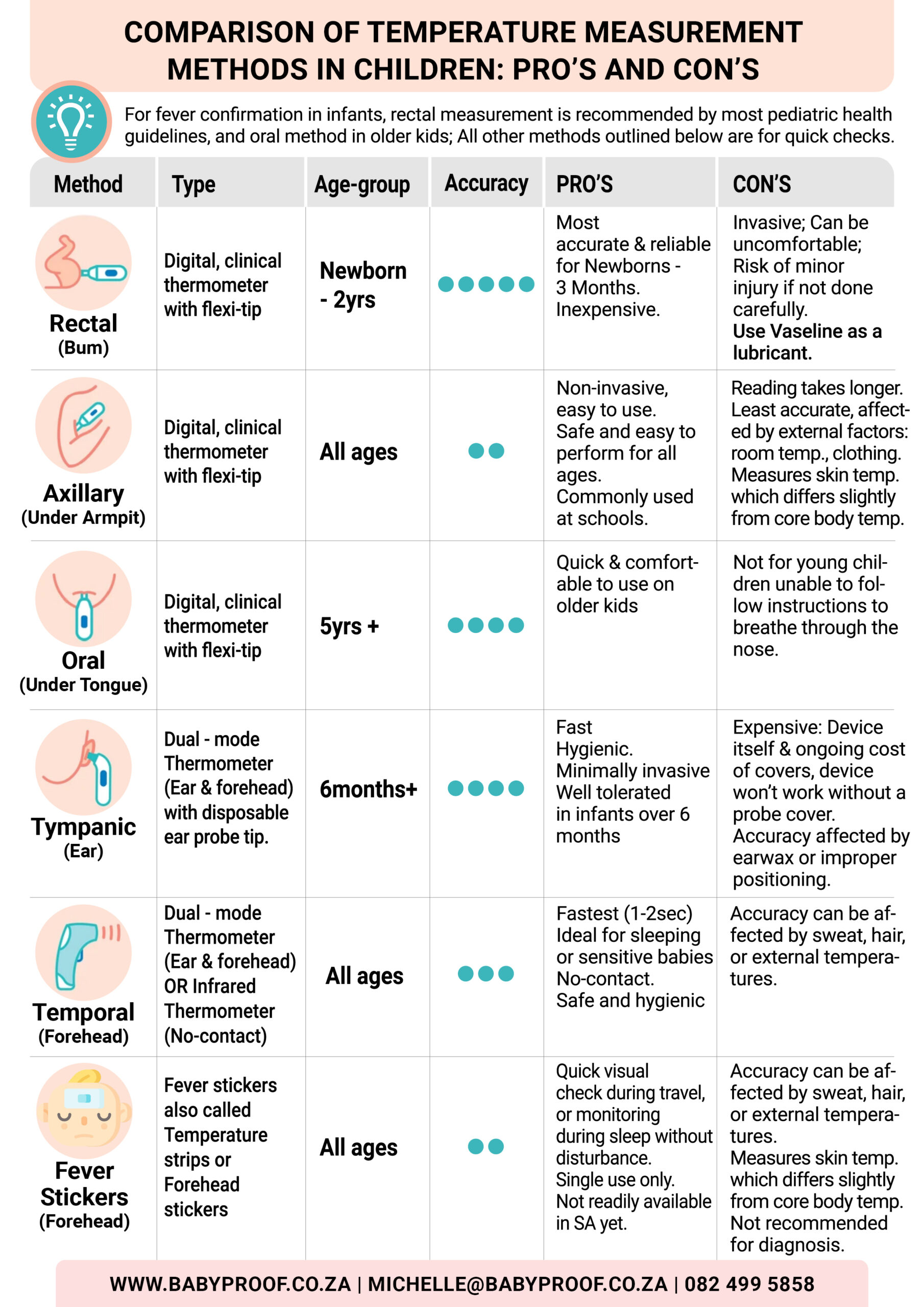
best-methods-to-measure-body-temperature-by-childs-age
CLICK HERE TO DOWNLOAD FREE PRINTABLE COPY
The Significant Impact of Accurate Temperature Readings on Health Outcomes
Obtaining precise temperature readings is vital for diagnosing medical conditions and monitoring overall health, especially in a country like South Africa, where diverse environmental factors can significantly affect physiological responses. Healthcare professionals in clinical settings depend on accurate temperature measurements to make informed treatment decisions. For instance, an incorrectly recorded temperature can lead to unnecessary treatments or delays in addressing critical health issues. Additionally, in community health initiatives, ensuring precise temperature readings can greatly enhance the effectiveness of public health responses, particularly during outbreaks of infectious diseases. Consequently, the importance of accuracy in temperature measurement cannot be overstated, as it has a direct impact on patient outcomes.
Understanding the Influence of Altitude on Temperature Measurement Accuracy
South Africa’s varied altitudes create unique challenges for temperature measurement accuracy. Areas such as <a href=”https://limitsofstrategy.com/bryanston-golf-club-a-tranquil-escape-in-johannesburg/”>Johannesburg</a>, located roughly 1,753 metres above sea level, may exhibit fluctuations in body temperature readings compared to coastal cities like Durban. Elevated altitudes can trigger changes in body metabolism and thermoregulation, necessitating careful adjustments when interpreting temperature readings. Healthcare providers must recognise these variations when assessing patients from different regions. For example, a fever in a patient from a high-altitude area may manifest differently than in someone from a lower elevation. Acknowledging these subtleties is crucial for accurate health evaluations and tailored patient care.
Innovative Developments in Temperature Monitoring Technology
Recent years have seen remarkable advancements in technology aimed at improving the efficiency and accuracy of temperature monitoring in South Africa. Innovations such as infrared thermometers and digital devices are increasingly being embraced in both clinical environments and home settings. These modern tools deliver swift readings and often feature user-friendly attributes, including backlit displays and memory capabilities. Furthermore, smartphone-connected thermometers are becoming more popular, allowing users to track temperature readings over time and easily share this information with healthcare providers. These technological advancements not only streamline the temperature measurement process but also have the potential to enhance health outcomes by enabling timely medical interventions.
Mastering the Techniques for Oral Temperature Measurement in South Africa
A Step-by-Step Approach to Accurately Taking an Oral Temperature Reading
Obtaining an accurate oral temperature reading is a straightforward procedure that involves placing the thermometer beneath the tongue while ensuring that the mouth remains closed to guarantee an accurate measurement. Before taking the reading, it is crucial to confirm that the patient has avoided consuming any hot or cold foods or beverages for at least 15 minutes, as these can significantly skew the results. Once the thermometer is properly placed, one should wait for the device to indicate that the reading is complete, typically signalled by a beep. Educating patients and caregivers on this method is essential to ensure correct execution, thus preventing inaccurate readings. This technique is commonly employed in South African households, making it accessible for family members to conveniently monitor their health.
The Advantages of Using Oral Temperature Measurement Techniques
Oral temperature measurement boasts numerous advantages, making it the preferred choice in many South African households and healthcare settings. Primarily, this method is non-invasive, significantly reducing the discomfort often associated with alternative temperature-taking techniques. Additionally, it is user-friendly, allowing individuals to take readings without requiring professional assistance. This convenience is particularly beneficial for quick checks at home, where families can easily monitor fevers in both children and adults. Furthermore, oral thermometers typically yield rapid results, generally within one to two minutes, facilitating prompt health decisions. In the fast-paced environments of South Africa, this efficiency is invaluable.
Limitations and Considerations of the Oral Temperature Measurement Method
While the oral temperature measurement method presents numerous benefits, it is not without its limitations. This technique may not be suitable for all patient demographics, particularly young children or individuals who cannot hold the thermometer in place for the required duration. Additionally, factors such as recent food or drink intake, smoking, or even breathing through the mouth can compromise the accuracy of readings. In South Africa, where environmental conditions can vary widely, outdoor temperatures may also affect readings if the thermometer is not used correctly. Therefore, when employing the oral method, it is essential to consider these factors to achieve the most accurate results possible.
Exploring Axillary Temperature Measurement Techniques in South Africa
Proper Techniques for Measuring Temperature Using the Axillary Method
The axillary temperature measurement method involves placing the thermometer in the armpit and ensuring that the arm is pressed closely against the body for an accurate reading. This technique is widely adopted in South African schools and childcare facilities due to its safety and ease of execution for individuals of all ages. It is crucial to ensure that the skin is dry and that the thermometer is positioned correctly to attain optimal accuracy. The reading may take longer than that of oral methods, often requiring several minutes. Educating caregivers and staff on the proper technique is vital to ensure that temperature readings are reliable and effective for identifying health concerns in both children and adults.
The Benefits of Axillary Temperature Measurement Techniques
Axillary temperature measurement offers several advantages, particularly in public health settings across South Africa. One of the main benefits is its non-invasive nature, making it safe for individuals of all ages, including infants and the elderly. The simplicity of this method allows for quick execution in school health programmes or health fairs, where time constraints may be present. Furthermore, the axillary approach is cost-effective, requiring fewer resources compared to advanced digital or infrared thermometers. This accessibility is especially crucial in rural areas, where healthcare resources may be limited. The safety and ease of axillary measurements make them an excellent option for community health initiatives.
Factors Influencing the Accuracy of Axillary Temperature Measurements
Despite its advantages, several factors can affect the accuracy of temperature readings obtained through the axillary method. Environmental conditions, such as high ambient temperatures or humidity prevalent in South Africa, may lead to elevated readings due to perspiration, potentially indicating a false fever. Additionally, clothing can create insulation, hindering heat exchange, which may distort results. Movement during the measurement process, especially in children, can also lead to inaccurate readings. Thus, healthcare providers and caregivers must be aware of these factors and implement measures to mitigate their impact, such as ensuring the arm remains close to the body and that the skin is dry before taking measurements.
Understanding Rectal Temperature Measurement Techniques in South Africa
Steps to Accurately Measure Rectal Temperature
Accurately measuring rectal temperature involves several steps to ensure both precision and patient comfort. First, it is essential to apply lubricant to the tip of the thermometer to facilitate gentle insertion. The thermometer should be inserted approximately an inch into the rectum while being held securely, waiting for the reading to complete. This method is often employed in South African hospitals due to its accuracy, particularly in critical care scenarios or when monitoring infants. Given its sensitivity, performing the process gently and with the patient’s comfort in mind is crucial to maintain trust and cooperation from patients, especially those who are vulnerable.
The Reasons Rectal Temperature Measurement is Considered the Most Accurate
Rectal temperature measurements are widely regarded as the most accurate compared to oral and axillary methods, making them ideal for critical care situations in South Africa. This accuracy is particularly essential in emergency contexts or when dealing with unresponsive patients, as healthcare professionals depend on precise temperature information to guide treatment decisions. Additionally, rectal thermometers are less susceptible to external variables, such as ambient temperature or recent oral intake, making them a reliable option in clinical practice. In paediatric care, especially for infants, rectal measurements provide a definitive assessment of core body temperature, enabling timely and appropriate medical responses.
Important Considerations and Precautions for the Rectal Measurement Method
While the rectal measurement method offers several advantages, it also necessitates particular considerations and precautions. The insertion process can be uncomfortable, potentially leading to patient resistance, particularly in non-clinical settings. Therefore, it is vital to clearly explain the procedure and reassure the patient to foster cooperation. Furthermore, healthcare providers must adhere to strict hygiene protocols to prevent potential infections or injuries. Due to these concerns, rectal measurements are less frequently performed in home settings across South Africa. Nonetheless, understanding when and how to utilise this method is critical for healthcare professionals to ensure the utmost care and accuracy in temperature monitoring.
Expert Perspectives on Choosing the Most Appropriate Temperature Measurement Method
Guidance from Healthcare Professionals in South Africa on Temperature Measurement
Healthcare experts in South Africa often recommend various temperature measurement methods based on multiple factors, including the patient’s age, health condition, and specific context. For instance, oral measurements are typically advised for adults and older children who can securely hold the thermometer. Conversely, axillary readings might be preferred for quick assessments in schools or community health screenings. Rectal measurements are generally suggested for infants or critically ill patients due to their accuracy. Below are some expert recommendations:
- For adults: Prefer oral or rectal readings for enhanced accuracy.
- For young children: Use axillary or rectal methods based on cooperation levels.
- For infants: Rectal measurements are the gold standard for precision.
- In school settings: Axillary readings are often sufficient for quick health checks.
- In emergencies: Prioritise rectal measurements for accurate assessments.
These recommendations underscore the importance of selecting a temperature measurement method tailored to the individual needs of each patient and the context in which care is provided.
The Impact of Environmental Conditions on Temperature Readings in South Africa
Environmental factors in South Africa significantly influence temperature readings, necessitating that healthcare providers take context into account while interpreting data. For example, in coastal regions where humidity levels are elevated, axillary temperature readings may be artificially raised due to excessive sweating, leading to potential misdiagnosis. Likewise, in colder areas, such as the Drakensberg, ambient temperatures can cause readings to drop, prompting healthcare professionals to remain vigilant about local conditions. Experts advocate that practitioners adjust their interpretation of temperature data based on these environmental variables, ensuring accurate assessments. This contextual awareness is essential for appropriate diagnosis and treatment.
Implementing Best Practices for Temperature Measurement in South Africa
Implementing best practices for temperature measurement is crucial in South Africa to guarantee accurate and reliable readings. These practices include regularly calibrating thermometers to maintain their precision, as poorly calibrated devices can yield misleading results. Moreover, healthcare providers should comprehend patient conditions and adapt their temperature measurement techniques accordingly. For instance, considering a patient’s hydration status can significantly influence readings. Providers should also educate patients and caregivers about the importance of using proper measurement techniques, including the timing of readings and understanding factors that may affect temperature. By adhering to these best practices, healthcare professionals can significantly enhance the quality of care delivered.
Cultural Beliefs and Their Influence on Temperature Measurement Preferences in South Africa
Cultural beliefs play a significant role in shaping temperature measurement preferences in South Africa. Various communities may favour specific methods based on traditional practices or comfort levels. For example, some cultures may prefer non-invasive methods such as axillary measurements due to a preference for less intrusive techniques. Acknowledging these cultural nuances is essential for healthcare providers to deliver culturally sensitive care. Engaging with communities to educate them about the benefits and limitations of each temperature measurement method can build trust and improve adherence to recommended practices. Moreover, respecting cultural beliefs while offering evidence-based recommendations can enhance patient cooperation and health outcomes.
Challenges in Implementing Various Temperature Measurement Methods in South African Health Facilities
Implementing temperature measurement methods in South African health facilities presents multiple challenges, including resource availability and staff training. In rural areas, healthcare facilities may lack access to modern temperature-taking devices, limiting effective monitoring. Additionally, staff may require ongoing education and training to ensure they are proficient in accurately using various measurement methods. High patient volumes in urban clinics can also lead to time constraints, resulting in rushed assessments and potential inaccuracies. Addressing these challenges through targeted training programmes and improved equipment access is vital for enhancing temperature monitoring practices throughout South Africa’s diverse healthcare landscape.
A Comparative Study of Oral, Axillary, and Rectal Temperature Measurement Methods
Identifying Key Differences Among Temperature Measurement Methods
The primary distinctions between oral, axillary, and rectal temperature measurement methods revolve around accuracy, ease of use, and suitability for various age groups and settings. Oral thermometers provide reliable readings and are frequently used for adults and older children. However, they necessitate patient cooperation, which may not always be feasible. Axillary temperature measurements are non-invasive and suitable for all ages, making them ideal for community screenings; however, they are generally considered less precise. Rectal measurements, often regarded as the most accurate, may cause discomfort and might not be suitable for all patients outside clinical environments. Understanding these differences is essential for selecting the most appropriate method for each specific situation.
Assessing Accuracy and Reliability Across Different Temperature Measurement Methods
In South Africa, the accuracy and reliability of temperature readings vary across different measurement methods. Rectal measurements are generally acknowledged as the most precise, closely reflecting core body temperature. Oral measurements follow, providing reliable readings when performed correctly, while axillary measurements typically yield the least accurate results. This hierarchy of accuracy guides healthcare providers in their choices, particularly when assessing febrile patients or making critical care decisions. For instance, in emergency situations, rectal readings may take precedence to ensure precise monitoring of patients’ conditions. Recognising the limitations of each method can significantly improve healthcare quality in South Africa.
Determining the Suitability of Each Temperature Measurement Method in South African Contexts
The appropriateness of each temperature measurement method within South African contexts is influenced by various factors, such as the setting and the patient’s specific needs. In home environments, oral measurements are often preferred for older children and adults due to their convenience. In contrast, axillary measurements may be standard in schools or during community health campaigns, where quick assessments are necessary. Rectal measurements, while ideal for precise monitoring in clinical settings, may be less suitable for home use due to comfort concerns. Therefore, healthcare providers must carefully evaluate each situation, considering available resources and the patient’s condition to determine the most suitable temperature measurement method.
Practical Considerations for Effective Temperature Measurement in South Africa
Available Equipment and Resources for Temperature Measurement in South Africa
The variety of equipment and resources for temperature measurement in South Africa is vast. From basic digital thermometers to sophisticated clinical devices, the options available are extensive. In urban hospitals, cutting-edge technology is often utilised, including infrared thermometers that allow for rapid and contactless measurements. Conversely, in rural settings, basic thermometers may be the only option, potentially affecting the accuracy of readings. The availability and affordability of these tools greatly influence healthcare practitioners’ choice of methods across the nation. Ensuring that healthcare facilities, particularly in underserved areas, have access to reliable equipment is crucial for effective patient care.
Challenges Faced in Temperature Measurement Practices
Healthcare providers in South Africa encounter numerous challenges regarding temperature measurement. Limited resources, particularly in rural regions, can impede access to accurate and reliable thermometers. Furthermore, patient cooperation can sometimes be unpredictable, especially in children or individuals with cognitive impairments, complicating accurate measurement. Unique environmental factors, such as extreme heat or cold, can also interfere with readings and complicate assessments. Overcoming these challenges requires implementing strategies like community education initiatives, improving equipment access, and training healthcare providers on best practices for temperature measurement.
Strategies to Ensure Accurate Temperature Readings in South Africa
Achieving accurate temperature readings in South Africa involves several critical steps. First, healthcare providers should consistently evaluate their techniques to ensure adherence to best practices for each measurement method. Regular calibration of thermometers is also essential to maintain accuracy. Educating patients and caregivers about the significance of proper technique, including factors that can influence readings, such as recent food intake or environmental temperature, can greatly enhance assessment reliability. Practitioners should also consider the unique environmental conditions of South Africa to appropriately adjust their interpretation of readings, thus ensuring comprehensive patient care.
Proven Strategies for Selecting the Optimal Temperature Measurement Method
Identifying the Most Effective Temperature Measurement Method for South Africans
Selecting the best method for temperature measurement in South Africa necessitates careful consideration of several factors. First, the patient’s age and health condition play a significant role in determining the appropriate method. For instance, infants may require rectal measurements for accuracy, while older children may be better suited to oral or axillary methods. Additionally, the setting—whether in a clinical environment, at home, or during a community health event—should inform the choice of measurement. South Africans can adopt the following strategies to ensure informed decision-making:
- Assess the patient’s age and level of cooperation.
- Consider the urgency of the temperature assessment.
- Evaluate available equipment and resources.
- Be aware of environmental conditions that may affect readings.
By following these steps, individuals can ensure they select a method that yields reliable results.
Implementing Best Practices for Each Temperature Measurement Method in South Africa
Adopting best practices for temperature measurement is critical for all methods used in South Africa. For oral measurements, always confirm that the patient has not consumed anything that could affect readings beforehand. When conducting axillary measurements, keeping the arm close to the body and ensuring the skin is dry will yield more accurate results. Rectal measurements necessitate careful handling and clear communication with the patient to minimise discomfort. Best practices for each method include:
- Regularly calibrate thermometers to ensure accurate readings.
- Educate patients and caregivers on proper techniques.
- Consider environmental factors when interpreting results.
- Document findings accurately to facilitate ongoing health assessments.
Following these practices will enhance the reliability of temperature measurements and improve health outcomes throughout South Africa.
Strategies for Educating the South African Public on Temperature Measurement
Public education on temperature measurement is vital for enhancing health literacy across South Africa. Healthcare providers can establish clear guidelines that outline the importance of accurate temperature readings and how to measure them effectively. Community outreach programmes, workshops, and health fairs can serve as platforms for educating the public about various temperature measurement methods. Moreover, utilising local healthcare resources, such as clinics and hospitals, to disseminate information and provide demonstrations can improve understanding. By focusing on practical application and cultural relevance, healthcare professionals can foster a more informed public capable of effectively monitoring their health.
Evaluating Best Practices for Temperature Measurement in South Africa
Key Insights on Temperature Measurement Practices
Oral, axillary, and rectal temperature measurement methods each possess distinct advantages and limitations within the South African healthcare context. Understanding the unique characteristics of each method, including accuracy, ease of use, and age appropriateness, is crucial for effective health monitoring. By being aware of the environmental factors that can influence readings, healthcare professionals can make informed decisions that enhance patient care.
Recommendations for Healthcare Providers in South Africa
Healthcare providers in South Africa should consider individual patient needs, including age and health status, when selecting temperature measurement methods. Moreover, they should remain cognizant of available resources and the environmental context to ensure accurate assessments. Ongoing training and education on the latest best practices will further empower providers to deliver high-quality care in temperature monitoring.
Emerging Trends in Temperature Measurement Practices in South Africa
Future trends in temperature measurement may involve the adoption of advanced technologies, such as smart thermometers that connect to mobile applications for tracking health metrics. Enhanced public education initiatives can further elevate health literacy regarding temperature measurement. Additionally, tailored approaches that consider South Africa’s unique cultural and environmental contexts will improve the effectiveness of healthcare delivery in temperature monitoring.
Disparities Between Rural and Urban Settings in Temperature Measurement Practices
The choice of temperature measurement methods may vary dramatically between rural and urban settings in South Africa. Limited access to advanced equipment in rural areas may necessitate reliance on simpler methods like axillary readings. In contrast, urban facilities often have access to a broader range of technological options, permitting more precise measurements. Addressing these disparities through targeted resource allocation and training is crucial to ensure equitable healthcare access.
The Influence of Cultural Practices on Temperature Measurement Preferences in South Africa
Cultural beliefs and practices significantly shape attitudes toward temperature measurement methods in South Africa. Understanding and respecting these beliefs is imperative for healthcare providers to deliver culturally sensitive care. By engaging with community leaders and incorporating culturally relevant practices into health education, providers can ensure that temperature measurement methods are accepted and effectively utilised within various cultural contexts.
Frequently Asked Questions Regarding Temperature Measurement Methods
Which method is considered the most accurate for measuring body temperature?
The rectal method is widely regarded as the most accurate for measuring body temperature, as it closely reflects core body temperature and is less influenced by external factors.
Can axillary temperature readings be relied upon for accurate diagnosis?
While axillary temperature is non-invasive and safe, it is generally less accurate than oral or rectal methods. However, it can still provide useful information in non-critical settings.
What is the appropriate procedure for taking an oral temperature reading?
To take an oral temperature, place the thermometer under the tongue, close the mouth, and wait for it to beep. Ensure that no hot or cold food or drink has been consumed beforehand.
What factors can compromise the accuracy of axillary temperature readings?
Factors such as ambient temperature, humidity, clothing, perspiration, and movement can all influence the accuracy of axillary temperature readings.
Is it safe to measure rectal temperature in a home setting?
While rectal measurements are accurate, they can be uncomfortable. They are generally recommended for infants or in clinical settings rather than at home unless advised by a healthcare professional.
What technologies are available for temperature measurement in South Africa?
In South Africa, a variety of technologies is available, ranging from basic digital thermometers to advanced infrared devices that enable quick, non-contact temperature measurements.
How frequently should thermometers be calibrated?
Thermometers should be calibrated regularly to ensure accuracy, ideally before significant use each season or at least once a year.
What actions should I take if my temperature reading is abnormal?
If a temperature reading is abnormal, especially if accompanied by other symptoms, it is advisable to seek medical advice for further evaluation and potential treatment.
Are there cultural preferences for temperature measurement methods in South Africa?
Yes, cultural beliefs can impact preferences for specific temperature measurement methods. Understanding these beliefs is vital for providing culturally sensitive healthcare.
How can I learn more about temperature measurement techniques?
You can learn more about temperature measurement techniques through local healthcare providers, community health workshops, and online resources dedicated to health education.
Check out our vibes on Instagram!
The article Best Method for Temperature: Oral, Axillary, or Rectal? A South African Guide was published first on: https://www.babyproof.co.za
The Article Temperature Measurement Methods: Oral, Axillary, or Rectal? Was Found On https://limitsofstrategy.com
The Article Temperature Measurement Methods: Oral, Axillary and Rectal Options found first on https://electroquench.com



It’s fascinating how temperature isn’t just a number on a thermometer, but a secret agent in the healthcare drama of South Africa! I mean, who knew that living at a high altitude could throw our body’s thermostat into overdrive? It’s like our bodies are adapting to their own version of “Survivor: Extreme Season”!
It’s true, temperature really does play a bigger role in our bodies than we often realize. Living at high altitudes, like in parts of South Africa, alters not only the air pressure but also how our bodies respond to it. It’s like a constant adjustment period for our internal systems—who knew we were all part of this ongoing “Survivor” challenge, right?